
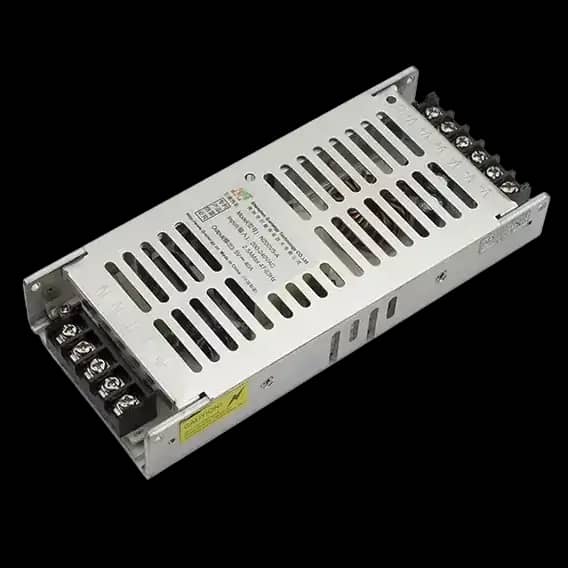
G-energy 5V40A LED Power Supply For LED Panel
৳ 1,800
An LED Display Power Supply is the electrical foundation of every LED Display system. It converts AC input power into stable 5V DC output for LED modules, receiving cards, hub boards, and cabinet electronics. If the power supply is undersized, poorly cooled, or mismatched with the cabinet load, even a good LED screen can show brightness drop, random flicker, scan instability, or repeated field failure.
This page is written as a technical buying guide for engineers, system integrators, installers, corporate buyers, event companies, and government procurement teams in Bangladesh. It explains how 5V LED power supplies are selected for indoor, outdoor, rental, and fixed installation screens, and then connects that engineering logic with the Arozex product catalog.
An LED display power supply is a regulated switching power supply that converts AC input into low-voltage DC output. Most LED display modules used in Bangladesh operate on 5V DC, so common cabinet power supplies are 5V40A, 5V60A, 200W, 300W, and 350W class units. The power supply does not create the video image. That job belongs to the LED controller, processor, receiving card, and module driver ICs. The power supply keeps those electronics fed with stable voltage under changing load.
A display load changes constantly. A full white image draws more current than a dark logo. A high-brightness outdoor screen pulls more current than a low-brightness indoor board. A large LED video wall may have dozens or hundreds of individual power supplies distributed across cabinets. Good power design keeps voltage stable during these changes, keeps heat under control, and gives technicians a predictable service path when a cabinet needs maintenance.
Power supply quality affects brightness consistency, refresh stability, LED module lifespan, receiving card reliability, and downtime cost. In a procurement document, power supply may look like a small accessory. On site, it is one of the most common reasons a screen becomes unstable after installation.
| Quality Factor | Field Impact | What to Check |
|---|---|---|
| Voltage stability | Prevents dim corners, flicker, and random cabinet behavior. | Measure 5V output under load, not only at idle. |
| Reserve capacity | Reduces heat and supports long daily operation. | Avoid running a power supply continuously at its maximum rating. |
| Protection circuit | Limits damage during short circuit, overload, or input fluctuation. | Confirm overload, over-voltage, and thermal protection where available. |
| Thermal design | Improves lifespan inside sealed or crowded cabinets. | Check airflow path, fan condition, dust, and mounting clearance. |
| Brand consistency | Makes replacement, documentation, and warranty support easier. | Use consistent models within the same display section where possible. |
Indoor screens normally use compact 5V switching power supplies installed inside cabinets or frame structures. They support lower environmental stress than outdoor screens, but they still need clean cabling, proper ventilation, and enough capacity for full-brightness operation. Fine pitch Indoor LED Display projects need especially careful voltage distribution because small pixel pitch modules place dense electronics in a compact area.
Outdoor cabinets face heat, rain exposure, dust, and line voltage variation. The power supply may be similar in output rating, but the complete cabinet design must protect it from moisture and allow heat to escape. For Outdoor LED Display installations, grounding, surge protection, waterproof cabinet sealing, and cable gland quality are as important as the power supply label.
Most modern LED screens use switching power supplies because they are compact, efficient, and suitable for distributed cabinet power. A switching power supply rapidly switches internal components to regulate DC output. The result is a practical combination of small size, high current, and stable voltage for LED display modules.
Some higher-capacity units use active fan cooling. Others rely on metal chassis heat dissipation and cabinet airflow. Industrial grade models are preferred for mission-critical sites such as control rooms, airports, transport terminals, shopping malls, and long-running corporate displays where service interruption is expensive.
In Bangladesh, common LED screen power supply discussions usually include Mean Well, G-Energy, Rong Electric, and Chuanglian. The right brand depends on project risk, budget, stock availability, documentation needs, and service policy. Arozex evaluates the full screen architecture before recommending a model.
| Brand | Typical Use | Strength | Buyer Note |
|---|---|---|---|
| Mean Well Power Supply | Premium fixed installations, corporate displays, industrial projects. | Strong documentation, recognized quality, stable long-term use. | Higher price, often selected where specification compliance matters. |
| G-Energy Power Supply | LED cabinets, signage displays, replacement parts, practical projects. | Good value, common 5V models, suitable for many LED panel applications. | Confirm genuine source, load reserve, and cabinet ventilation. |
| Rong Electric | Common LED display builds and field replacements. | Practical availability and familiar form factors. | Check project consistency before mixing with other brands. |
| Chuanglian | LED cabinet manufacturing and replacement use. | Known in LED display supply chains. | Verify rating, terminal layout, and after-sales availability. |
The most common LED screen power supply specification is not just voltage and current. Engineers also check AC input range, DC voltage tolerance, conversion efficiency, operating temperature, protection features, size, terminal layout, and heat path. For Bangladesh projects, AC input fluctuation and long daily operating hours should be considered during selection.
| Specification | Common Value | Engineering Meaning |
|---|---|---|
| Output voltage | 5V DC | Standard operating voltage for most LED display modules and cabinet electronics. |
| Output current | 40A or 60A | Maximum available current. Use reserve margin instead of loading at full rating. |
| Rated power | 200W, 300W, 350W | Voltage multiplied by current. A 5V40A supply is about 200W rated output. |
| Input voltage | AC 90V-264V depending on model | Wide input range helps with practical site conditions and voltage variation. |
| Cooling | Fanless chassis or fan cooling | Cooling design must match cabinet airflow, dust level, and operating duration. |
| Protection | Short circuit, overload, over-voltage | Protection reduces damage risk but does not replace correct design and wiring. |
The correct power supply is selected from load calculation, not from cabinet size alone. Two cabinets with the same size can have different power needs if the pixel pitch, scan type, LED lamp package, brightness target, and module design are different. A P2.5 indoor cabinet and a P6 outdoor cabinet should not be treated as the same electrical load.
| Selection Check | Recommended Practice |
|---|---|
| Cabinet size | Confirm whether the cabinet is 640x480, 640x640, 500x500, 500x1000, or another format. |
| Module power | Use manufacturer power data for each LED module and calculate cabinet total load. |
| Brightness target | Outdoor displays and high-brightness signage need more reserve capacity. |
| Service method | Front-service cabinets may need different replacement access than rear-service cabinets. |
| Future expansion | For scalable LED video walls, keep consistent power models and spare stock planning. |
| Operating hours | 24/7 sites should use stronger reserve margin and better thermal management. |
A power supply works inside a system. It must fit the electrical load of the LED modules, physical layout of the LED cabinet, grounding scheme, receiving card placement, and controller workflow. The power supply does not directly decide video format, but unstable power can look like a controller or receiving card fault during troubleshooting.
| Compatible Part | What to Verify | Risk if Ignored |
|---|---|---|
| LED modules | Voltage, maximum current, module quantity per supply, scan behavior. | Dim modules, heat stress, random flicker, early module failure. |
| Receiving cards | Stable 5V supply, clean wiring, shared ground, cabinet layout. | Card reset, data loss symptoms, unstable cabinet output. |
| Controllers | Power stability across cabinets connected to each controller output. | Troubleshooting confusion because power faults may mimic signal faults. |
| Power supplies | Same output rating, compatible mounting, matching terminal layout. | Uneven load distribution, difficult replacement, inconsistent service records. |
| Cabinet structure | Airflow, cable path, terminal access, front or rear service workflow. | Heat buildup, service delay, loose wiring after maintenance. |
A practical load calculation starts with module power. If a cabinet uses multiple LED modules, multiply the module peak wattage by the number of modules, then add power for receiving cards and small electronics. After that, apply reserve capacity. In many field projects, a 20 to 30 percent reserve margin is used to reduce heat and support stable long-term operation.
| Step | Engineer Action | Example |
|---|---|---|
| 1. Count modules | Confirm module quantity inside one cabinet. | A 640x480 cabinet may use several 320x160 modules depending on pitch. |
| 2. Check module wattage | Use actual module data sheet or supplier value. | If one module is 18W peak and there are 12 modules, peak module load is 216W. |
| 3. Add electronics | Include receiving card, hub board, fans, and small cabinet devices. | Add a practical allowance for cabinet electronics. |
| 4. Apply margin | Keep reserve instead of operating at maximum power supply rating. | A 300W load should not be planned on a single 300W supply for 24/7 use. |
| 5. Validate voltage | Measure voltage at module side under bright content. | Adjust wiring or distribution if voltage drop is visible. |
Installation quality decides whether a good power supply performs well in the field. Before installation, isolate AC power, verify input voltage, inspect cabinet grounding, and confirm the DC output polarity. Loose terminals are one of the most common causes of heat marks and intermittent power loss in LED cabinets.
| Installation Area | Best Practice |
|---|---|
| Mounting | Fix the power supply securely on the cabinet plate with enough clearance for heat dissipation. |
| AC input | Use correct cable size, protected circuits, proper earthing, and clean terminal tightening. |
| DC output | Keep 5V and ground wiring short, tidy, and correctly rated for cabinet current. |
| Polarity | Verify V+ and V- before connecting LED modules or receiving card power. |
| Ventilation | Keep airflow paths open and avoid packing excess cable around the supply body. |
| Labeling | Label cabinet power supply position so maintenance teams can trace faults quickly. |
For rental projects, technicians should inspect terminals after repeated transport and setup. For fixed outdoor projects, they should check moisture marks, dust, fan operation, and cabinet seals during preventive maintenance.
LED display power supply maintenance is simple when the system is documented. Keep a cabinet map, power supply model list, spare stock, and last service notes. This is especially important for public-facing screens where downtime affects advertising, public information, or event operations.
| Maintenance Task | Frequency | Purpose |
|---|---|---|
| Visual inspection | Monthly or before events | Find burn marks, dust buildup, loose wires, corrosion, or moisture signs. |
| Voltage measurement | During service visits | Confirm 5V output under real display load. |
| Fan and airflow check | Quarterly for busy sites | Prevent heat-related failure in sealed or dusty environments. |
| Terminal tightening | After transport or vibration | Avoid intermittent faults and high-resistance heating. |
| Spare replacement test | Before major campaigns | Confirm spare power supplies match the installed cabinet design. |
Many LED display faults look like controller or receiving card problems at first. A disciplined technician checks power early because unstable 5V output can create random symptoms. Always follow electrical safety practices and isolate power before touching cabinet wiring.
| Symptom | Likely Power Cause | Recommended Check |
|---|---|---|
| Cabinet is completely off | No AC input, blown fuse, failed power supply, loose terminal. | Check breaker, AC input, indicator LED, and 5V output. |
| One module row is dim | Voltage drop, weak DC distribution, loose output wire. | Measure voltage at module connector while bright content is displayed. |
| Random flicker | Power supply overload, unstable output, poor ground. | Reduce load, inspect ground, test with a known good supply. |
| Receiving card resets | Insufficient 5V supply or loose receiving card power connector. | Check receiving card input voltage and terminal tightness. |
| Power supply runs hot | Overload, poor ventilation, dust, fan fault. | Check load calculation, airflow, dust condition, and cabinet temperature. |
| Outdoor cabinet fails after rain | Moisture ingress or corrosion around power components. | Inspect cabinet seal, cable glands, drain path, and terminal corrosion. |
LED display power supply price in Bangladesh depends on brand, current rating, wattage, input range, build quality, availability, and project quantity. A 5V40A unit is usually lower cost than a higher-capacity 5V60A or premium industrial model. For procurement, price should be compared against project risk. A small saving on each power supply can become expensive if it causes repeated service visits on a large screen.
| Buying Factor | How It Affects Price | Recommended Decision |
|---|---|---|
| Brand | Premium brands cost more but may provide stronger documentation and consistency. | Use premium models for high-risk or specification-driven projects. |
| Current rating | 40A units are common; 60A units may cost more but support higher load. | Do not choose rating only by price. Calculate cabinet load first. |
| Quantity | Large projects may qualify for better unit pricing and spare planning. | Order spares with the same batch when possible. |
| Application | Outdoor, 24/7, and public installations need better thermal and protection planning. | Treat power design as part of system reliability, not a small accessory. |
The most common mistake is selecting by output voltage only. A power supply can be 5V and still be wrong for the cabinet because current capacity, thermal behavior, physical mounting, input range, or replacement workflow does not match the project.
| Display Type | Power Supply Planning | Related Resource |
|---|---|---|
| Indoor LED display | Compact 5V supplies with clean cabinet wiring, stable voltage, and low-noise thermal planning. | Indoor LED Display |
| Outdoor LED display | Weather-protected cabinet design, surge protection, grounding, and stronger thermal margin. | Outdoor LED Display |
| Rental LED display | Durable mounting, repeat setup inspection, and spare units for event continuity. | Rental LED Display |
| LED video wall | Consistent power zones, documented cabinet map, and predictable service access. | LED Video Wall |
An LED display power supply converts AC input power into stable low-voltage DC output, usually 5V DC, for LED modules, receiving cards, hub boards, and cabinet electronics.
5V40A means the power supply outputs 5 volts DC and can deliver up to 40 amps of current. The practical output capacity is around 200W before applying a safety margin.
The quantity depends on module power consumption, cabinet size, brightness level, redundancy requirement, and installation environment. Engineers normally calculate peak load and then keep 20 to 30 percent reserve capacity.
No. The voltage may match, but LED display power supplies must also match current capacity, heat tolerance, protection features, cabinet fit, terminal layout, and long-running reliability requirements.
Mean Well is often selected for premium industrial projects where documentation and long-term consistency are important. G-Energy is widely used for practical LED cabinet builds and replacement work where value, availability, and stable 5V output are priorities.
They can use similar 5V switching power supplies, but outdoor cabinets need stronger environmental planning, weather protection, ventilation, grounding, and moisture management.
Common causes include overload, poor ventilation, moisture, weak AC input, loose terminals, dust buildup, lightning surge, bad grounding, and running too close to rated capacity for long periods.
Yes. Arozex Technologies supplies LED display power supplies in Bangladesh and helps verify compatibility with LED modules, cabinets, receiving cards, controllers, and installation conditions.
Share your LED module model, cabinet size, pixel pitch, display size, installation location, and current power supply photo. Arozex Technologies can help calculate load, verify replacement compatibility, and supply the right LED display power supply in Bangladesh.
Contact Arozex